Ninmah, Ninhursag
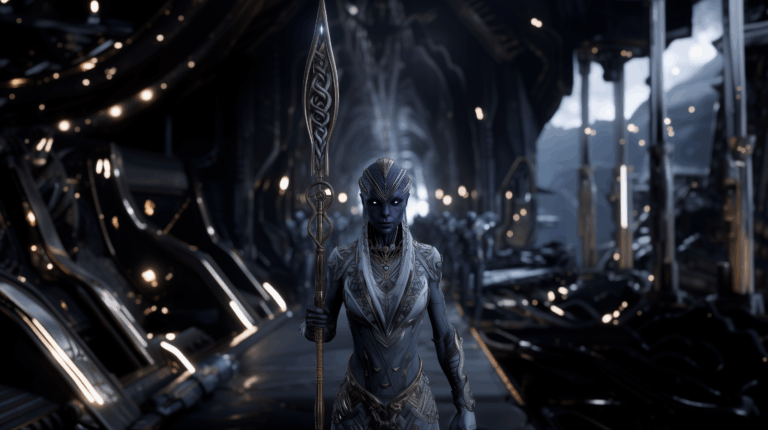
This divine drama has parallels in human affairs, as evidenced by the Sumerian texts that describe the creation of humanity by Ninhursag, using methods developed by Enki. Ninhursag was the chief medical officer among the gods, known as Ninti, which means both “lady of life” and “lady of the rib,” echoing the biblical story of Eve.
An ancient Mesopotamian myth recounts the creation process led by Ninmah and Enki, showcasing the complex and often imperfect nature of early human life. According to the text, Ninmah begins by taking clay from the Abzu, the subterranean freshwater realm, and shaping it into human forms with distinct impairments. Each creation receives a unique fate decreed by Enki, reflecting the gods’ intentions and the variety of human conditions.
First, Ninmah crafts a man with weak, outstretched hands that cannot bend. Enki observes this man and assigns him the role of a servant to the king, indicating the necessity of every being, despite physical limitations.
Next, Ninmah shapes a man who “turns back the light” and has perpetually open eyes. Enki interprets this creation as a musician, granting him the position of a chief in the king’s court, symbolizing the association of sensory awareness with artistic gifts.
The third creation is one with broken feet, unable to walk. Enki decides this individual’s role would be related to metalwork, particularly silversmithing. Another version of the text presents the third creation as an “idiot,” who is also appointed to serve the king, emphasizing utility even in cognitive limitations.
Ninmah then fashions a fourth being unable to control urination. Enki responds by bathing this person in enchanted water, driving out a demon, the namtar, showcasing an early form of healing and purification.
The fifth creation is a woman unable to give birth. Enki designates her to serve in the queen’s household, or as a weaver according to another manuscript, highlighting adaptability in divine decisions regarding human destinies.
Sixth, Ninmah creates an individual without genitalia, whom Enki names the “Nibru eunuch,” appointing this being to serve before the king, indicating a specific societal role beyond reproductive functions.
At this point, Ninmah becomes frustrated, throwing the clay to the ground in silence. In response, Enki proposes a challenge: he will create a new being, and Ninmah must decide its fate. Enki molds a figure with distorted features—its head, eyes, neck, lungs, and other body parts afflicted. This creation, called Umul, is severely impaired, unable to feed itself or move properly, symbolizing the vulnerability of life and the gods’ experimental approach to creation.
The Mesopotamian Mother Goddess, often referred to as Nintud or Nintur, Ninmah, Belet-ili, or Mami, embodies the principles of creation, fertility, and childbirth. As a central figure in early Mesopotamian religion, she was venerated for her vital role in guiding pregnancies, ensuring safe births, and nurturing life itself. Her domain extended beyond childbirth to include the creation of humankind, establishing her as one of the most influential deities in the ancient pantheon. The label “mother goddess,” while commonly used, is more of a convenient term rather than a precise title, as many goddesses could assume maternal roles within the broader Mesopotamian divine hierarchy.
During the third and second millennia BCE, the Mother Goddess held a prominent status among the gods, appearing alongside deities such as An, Enlil, and Enki in texts like The Lamentation over the Destruction of Sumer and Ur and The Lament over Nibru. Over time, however, her influence waned, with goddesses like Gula, associated with healing, and Ishtar, linked to love and war, taking precedence. Nevertheless, her core functions remained tied to childbirth, encompassing both the guidance of unborn children and their sustenance after birth.
The Mother Goddess is recognized as a creator deity, especially in the Atrahasis myth, where she forms humanity by mixing clay with the blood of a slain god. This process mirrors a tale from the Enki and Ninmah myth, where she competes with Enki in the creation of various beings, ultimately resulting in humans crafted from the clay of the abzu, the cosmic waters beneath the earth. Legends associated with Mami further detail her creative role: she shapes fourteen pieces of primordial clay into womb deities, producing the first seven pairs of human embryos. Additionally, under Enki’s suggestion, the gods sacrificed one of their own, using its blood and flesh, mixed with clay, to create humankind. Despite the central role she played in creation, the Mother Goddess’s functions were gradually absorbed by male deities, such as Enki in the Enūma eliš, marking a shift in divine authority often described as the “marginalization of goddesses” in later literature.
The divine genealogy of the Mother Goddess remains complex and ambiguous. She is occasionally linked as a consort to gods like An, Enlil, Enki, or Shulpae, with numerous offspring that emphasize her prolific role as a creator. Early god lists, such as the An-Anum, record various names and epithets associated with her, underscoring her extensive influence across the pantheon.
Her primary cult center was the city of Keš, an important yet-to-be-located site sacred to her worship. Keš is believed to be part of Urusagrig, near Adab, and maintained religious significance even into the Neo-Babylonian period, as evidenced by inscriptions from King Nabonidus. Other cities that housed temples dedicated to the Mother Goddess include Adab, Assur, Babylon, Lagaš, Larsa, Mari, Nippur, Sippar-Aruru, Susa, Umma, and Ur, indicating her widespread veneration across Mesopotamia.
The worship of the Mother Goddess traces back to the Early Dynastic period, continuing into the first millennium BCE. However, as male deities gained greater prominence, her influence diminished during the latter part of the second millennium BCE. Her iconography is distinguished by the one symbol that is believed to represent the uterus. This symbol is occasionally paired with a knife, symbolizing the cutting of the umbilical cord after birth.
The Mother Goddess is known by several names, each with distinct meanings. Ninmah translates to “Magnificent Queen,” while Nintud or Nintur, meaning “Queen of the (birthing) hut,” emphasizes her association with childbirth. The term tur relates to the Sumerian word for uterus, reinforcing her connection to life’s creation. Her Akkadian name, Belet-ili, means “Queen of the gods,” signifying her esteemed position among the divine.
Written representations of her name exhibit various spellings depending on the language and context. Ninmah appears as d-nin-mah, while Nintud or Nintur is rendered as d-nin-tur, d-nin-tu-ra, among other forms, and Belet-ili as d-be-let-dingirmesh. Despite these linguistic variations, the Mother Goddess consistently symbolizes the essence of creation, nurturing, and maternal care throughout Mesopotamian tradition.
Ninmah, also known in various texts as Ninharsag, Nintu, or Mama, holds a revered and foundational role among the Anunnaki. She is the half-sister of Enki and Enlil, sharing the same father, Anu, but born of a different mother. As a high-ranking female deity, she is often referred to as the Chief Medical Officer or “Mother of All Life” due to her pivotal role in the genetic creation of humankind.
Her most defining act within the Anunnaki narrative is her participation in the creation of the Adamu, the first model of the human being. This moment comes during the critical turning point in the Anunnaki mission when the Igigi, the lower-ranking gods, revolt against their harsh labor conditions in the gold mines of southern Africa. To resolve this crisis, Enki proposes the creation of a worker being—a hybrid crafted through genetic manipulation. Ninmah is the one who accepts the task and leads the medical and scientific efforts, combining the Anunnaki’s own genetic material with that of an existing hominid species on Earth.
The process is described as both experimental and sacred. Several early attempts result in failed beings—mutations that lacked balance or longevity—until a viable human form is finally achieved. This creature, capable of labor and reproduction, is seen as both a scientific success and a divine act. Throughout this endeavor, Ninmah demonstrates deep empathy and maternal instinct toward the human race, often interceding on their behalf.
Her character reflects the archetype of the divine mother, healer, and wise guardian of life. Despite her high status, she chooses not to compete for rulership or territorial dominion, focusing instead on healing, fertility, and moral judgment. In the Atrahasis Epic and other Mesopotamian texts, Ninmah is portrayed as a powerful, compassionate presence who weeps for humanity and expresses sorrow when humans suffer as a result of divine decrees.
Ninmah’s lineage and offspring are less emphasized in the texts, and she is often seen more as an autonomous figure—respected by both Enki and Enlil for her wisdom, neutrality, and life-giving power. Her temple, believed to be located in the region of Shuruppak, was a place associated with healing and birth.